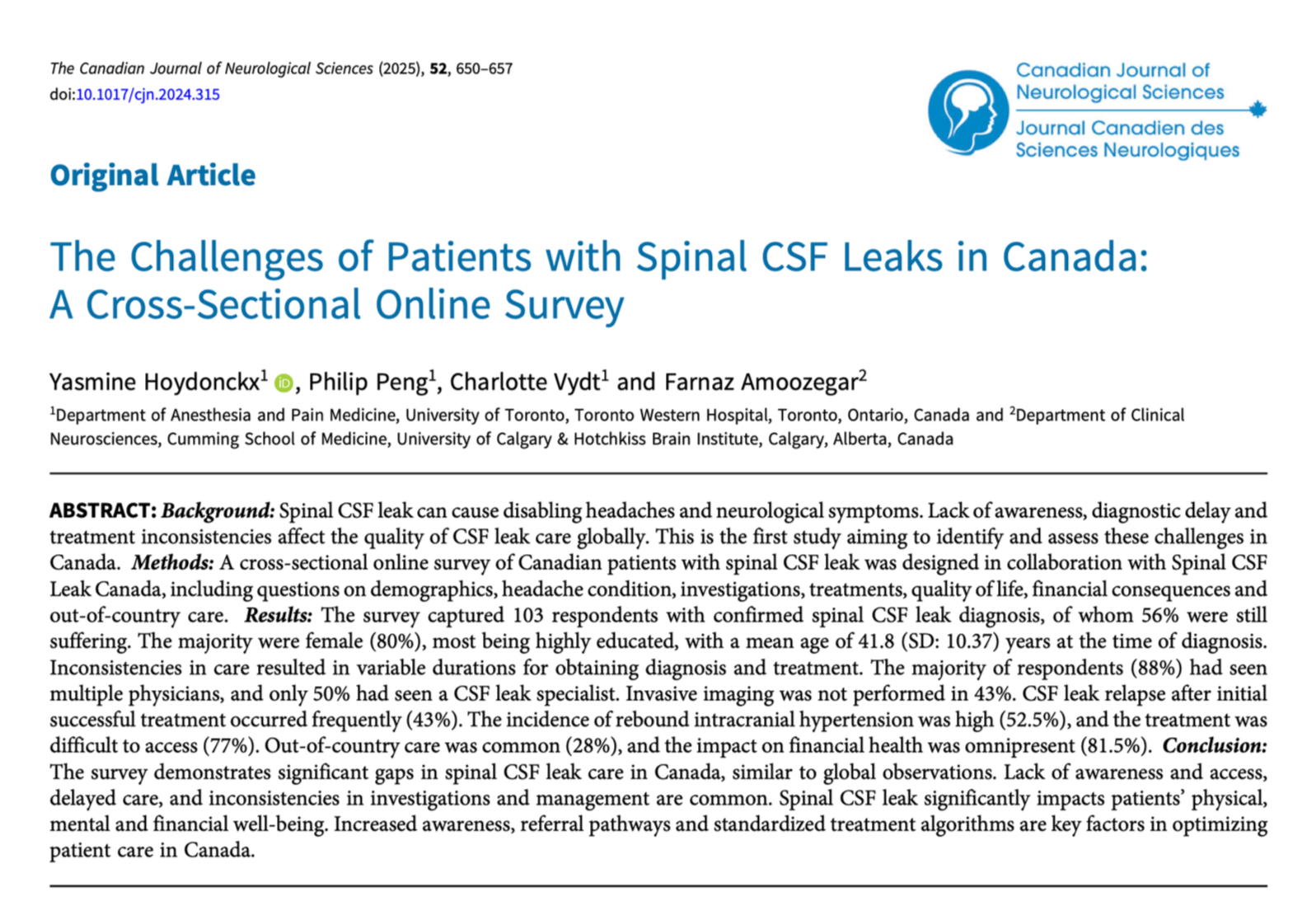
The Spinal Cerebrospinal Fluid (CSF) Leak of Canada is a national health charity, with a mission to improve the lives of patients suffering from spontaneous intracranial hypotension (SIH) or spinal CSF leak. This mission is achieved through advocacy and initiatives to raise awareness, education of patients and the Canadian medical community, and support of research to advance knowledge and combat this highly disabling neurological condition.

Your tax-deductible donation helps us continue advancing awareness, supporting vital research, and bringing hope and healing to individuals living with SIH and spinal CSF leak.

Learn More & Register Here
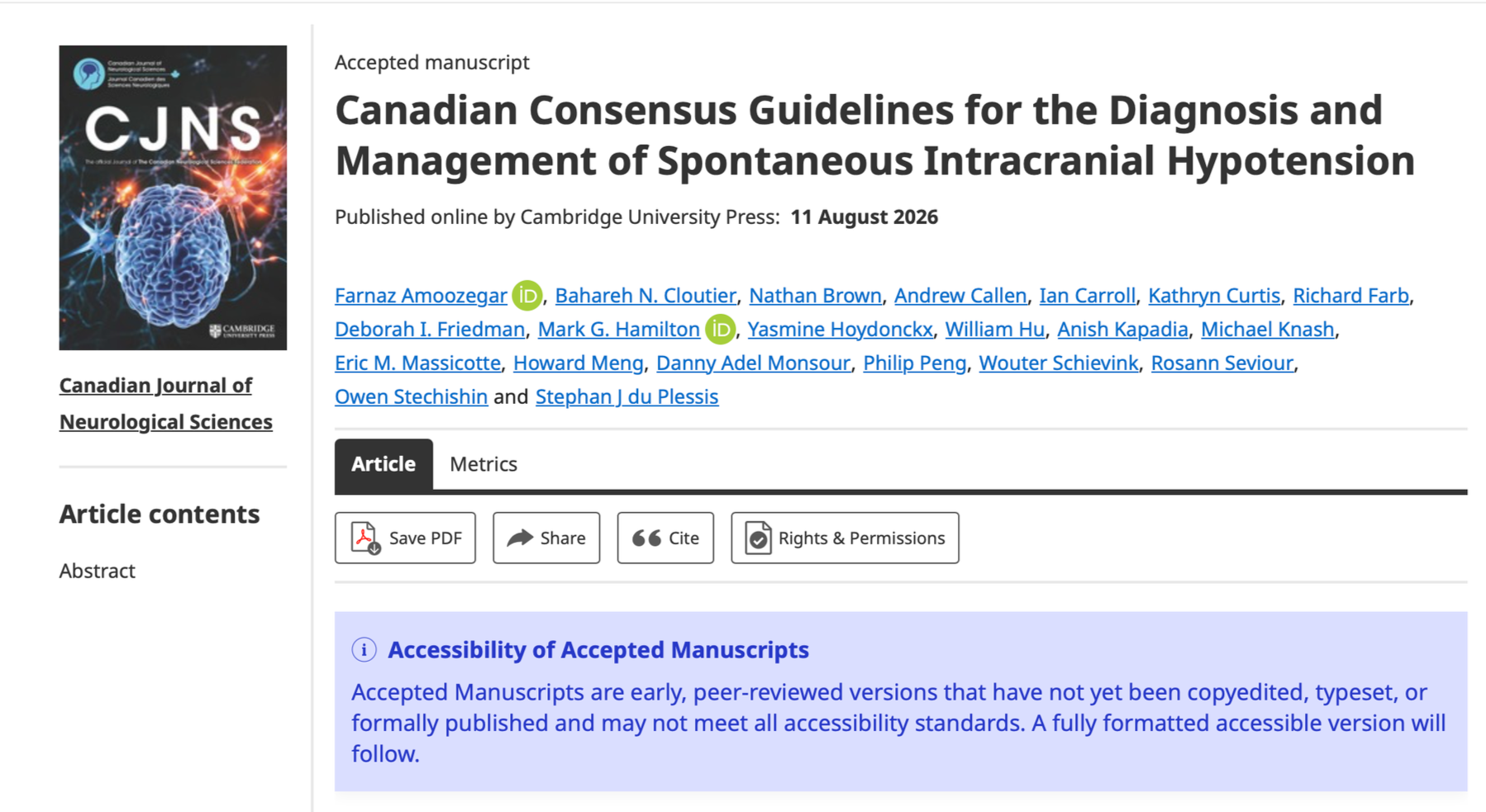
New Canadian Consensus Guidelines for the Diagnosis and Management of Spontaneous Intracranial Hypotension (SIH) is now published online!
〰️
New Canadian Consensus Guidelines for the Diagnosis and Management of Spontaneous Intracranial Hypotension (SIH) is now published online! 〰️
-
Intracranial Hypotension (IH) or Spontaneous intracranial hypotension (SIH) is a highly disabling neurological condition caused by leakage of cerebrospinal fluid (CSF), through the dura mater, the fibrous tissue (the outermost layer of the meninges, surrounding the spinal cord) that contains CSF, either through a tear or defect, ruptured nerve root sleeve, or directly into a paraspinal vein aka a CSF venous fistula (CVF).
-
A spinal CSF leak stems from a tear or abnormality in the dura. A spinal CSF leak can occur unprovoked (called spontaneous intracranial hypotension (SIH)), may happen as a result of certain medical procedures (called “iatrogenic”) or be caused by a sudden traumatic event.
-
One of the most common symptoms of a spinal CSF leak is a moderate to severe orthostatic headache. This means that the patient feels partial or complete relief of the headache when lying down flat, and the patient’s headache worsens considerably when upright.
A spinal CSF leak can also lead to other possible neurological symptoms.
Learn more about non-headache symptoms, rare presentations, and long-term complications.
-
Under-diagnosis and/or misdiagnosis of a spinal CSF leak/ Spontaneous intracranial hypotension (SIH) is extremely common, resulting in little or no treatment for some patients suffering from it. Currently, there is not a single diagnostic test that can rule out SIH with a high degree of certainty; therefore, detailed assessment and investigation of symptoms by a specialist is crucial.
-
The treatment approach should be guided by the type and location of the leak, as determined through the diagnostic workup.
-
After being treated for a spinal CSF leak, there are steps that can be taken to enhance the prospect of being sealed.
It is recommended to remain flat on your back or on your side, keeping your head level with or lower than your chest as much as possible during the first 24 hours following the epidural blood patch or fibrin sealant injection. The only exceptions are brief time periods to eat or use the washroom; then return to lying down as soon as possible.
-
Rebound intracranial hypertension (RIH) caused by a rebound increase in CSF pressure is experienced by many patients after a CSF leak is successfully sealed. In other words, the pendulum may swing rapidly in the opposite direction leading to excess volume of CSF. This means that in contrast with a low-pressure headache, a new high-pressure headache may develop which feels significantly worse when the patient is flat. Many people find the location of the head pain switches from occipital to frontal.